Teaching and Learning at Carlton Miniott Primary Academy
At Carlton Miniott Primary Academy, children’s learning is purposeful, joyful and rooted in curiosity. Our teachers and support staff know the pupils well and understand what excites them, what challenges them and how to stretch their thinking. Our lessons are clear and well‑structured, but they’re also flexible enough to follow a great question or an unexpected spark of interest. Children are active participants rather than passive listeners: they talk, explore, question, collaborate and reflect. Within all areas of school life, we promote and encourage the children to learn and follow our school values: respect, community, learning, kindness and well-being.
The Carlton Miniott Way.
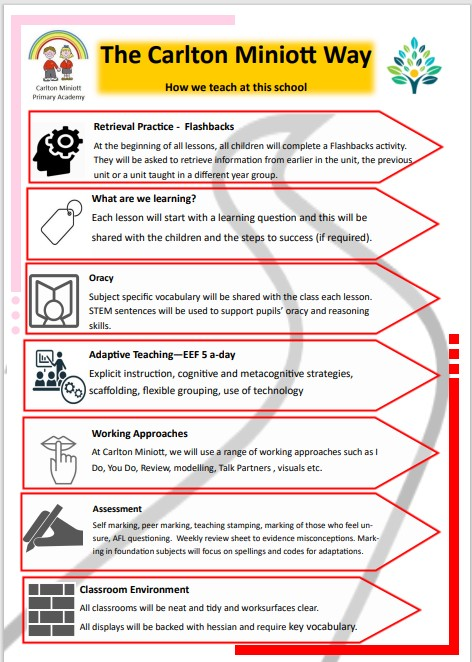
For each lesson, we follow a teaching structure that supports the children in each stage of their learning.
· Retrieval Practice
· Learning question
· Oracy/Vocabulary
· Adaptive teaching
· Range of Working Approaches
· Assessment
Our classroom environments also support and encourage focussed learning. English and maths working walls mirror the lesson objective, display relevant vocabulary and are an excellent tool for children to access during their independent activity time. The History and Geography boards display the knowledge and skills needed for the specific unit of work and we celebrate children’s work on both classroom and communal displays.
Flashbacks
At Carlton Miniott, we promote long term learning by beginning each session with a flashback. These consist of 2 or 3 questions based on prior learning linked to the specific subject being taught.
In maths, pupils complete a “Ninja” task which recaps prior maths objectives and revises basic concepts such as: number bonds, multiplication and division facts, calculation.
Oracy
In order to further develop children’s language skills, specific vocabulary is shared with the class within each lesson. Teachers and Teaching Assistants also use Stem Sentences, these are an excellent resource for children who need support in developing well-structured answers and reasons.
The Carlton Miniott Way to Inclusive Teaching
Inclusive teaching at Carlton Miniott is our commitment to ensuring that every child feels valued, supported and able to thrive. It is the belief that all pupils—regardless of background, ability, language, or need—deserve access to high‑quality learning experiences that help them grow with confidence and curiosity. Inclusion is not an add‑on; it is the foundation of how we teach, how we plan and how we build our school community.
What Inclusion Means
Inclusion means creating a learning environment where differences are recognised, respected and celebrated. It involves:
- Removing barriers so that all children can participate fully in lessons and school life.
- Adapting teaching to meet a wide range of learning styles, strengths and needs.
- Ensuring belonging, so every child feels safe, understood and part of the class community.
- Working together with families, specialists and pupils to provide the right support at the right time.
At Carlton Miniott, inclusion is about seeing each child as an individual and making sure they have what they need to succeed—not expecting everyone to learn in the same way.
Why Inclusion Matters
Inclusive teaching is essential because it:
- Improves learning for everyone. When lessons are flexible and accessible, all pupils benefit from clearer explanations, varied activities and supportive structures.
- Builds confidence and wellbeing. Children who feel accepted and understood are more willing to take risks, ask questions and persevere.
- Promotes fairness and equality. Every child deserves the same opportunities to learn, grow and achieve their potential.
- Prepares pupils for life. Inclusive classrooms reflect the diverse world we live in, helping children develop empathy, respect, and collaboration skills.
- Strengthens our school community. When everyone is included, everyone thrives—pupils, staff and families alike.
The Carlton Miniott Approach
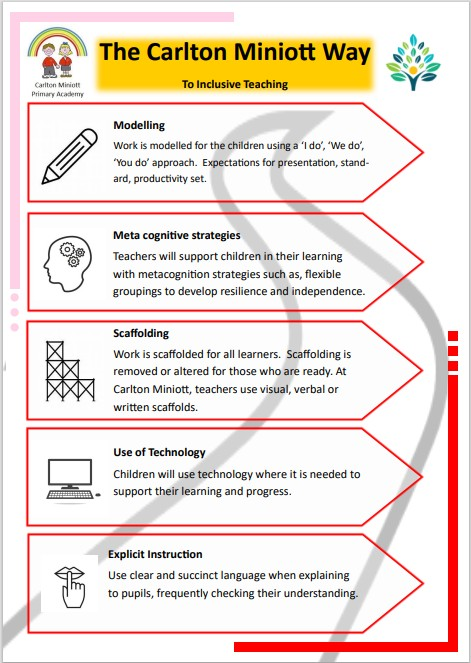
Modelling
Within lessons, teachers and support staff will model the learning for the children using an “I do”, “We do”, “You do” approach.
The I do – We do – You do approach is a gradual release model that helps pupils move from guided learning to confident independence. It structures a lesson so children first see a skill modelled clearly, then practise it with support, and finally apply it on their own. In a primary classroom, this approach is especially powerful because it provides security, clarity and scaffolding while still building independence.
Metacognitive strategies
Metacognitive strategies in our classrooms are ways of helping children think about their own thinking. They teach pupils to understand how they learn, plan their approach to tasks, monitor their progress and reflect on what worked well. These strategies build independence, resilience and deeper learning—skills that benefit our pupils across all subjects.
Why Metacognition Matters in Primary Education
· It improves attainment across subjects by helping children become active, reflective learners.
· It builds independence, reducing over-reliance on adults.
· It supports inclusion, as pupils learn strategies that help them overcome barriers.
· It develops resilience, teaching children that mistakes are part of learning.
· It prepares pupils for later schooling, where self-regulation becomes increasingly important.
Scaffolding
Scaffolding in a primary classroom means giving pupils the temporary support they need to access learning, and gradually removing that support as their confidence grows. Effective scaffolding uses a blend of visual, verbal, and written tools so children can understand new concepts, stay focused, and work more independently.
Visual scaffolds—such as diagrams, pictures, sentence stems, number lines, or colour‑coded steps—help pupils see the structure of a task and reduce cognitive load.
Verbal scaffolds involve the teacher modelling thinking aloud, asking guiding questions, or prompting pupils with key vocabulary to help them organise their ideas.
Written scaffolds, including checklists, word banks, success criteria, and partially completed examples, give children a concrete reference they can return to as they work.
When these forms of support are combined thoughtfully, they make learning more accessible, build independence and ensure that all pupils can participate successfully, regardless of their starting point.
Use of Technology
Technology in our classrooms supports learning by giving children interactive, accessible and engaging ways to explore new ideas. Digital tools such as tablets, learning apps and online platforms can reinforce key skills through games, quizzes and creative tasks, while also allowing pupils to work at their own pace.
Assistive technologies—like text‑to‑speech through the iPad —removes barriers for pupils who need additional support, ensuring everyone can participate fully. When used thoughtfully, technology enhances teaching, strengthens independence and opens up rich opportunities for collaboration and creativity.
Explicit Instruction
We use explicit instruction in lessons to ensure that children are taught new concepts with clear, concise language and therefore know exactly what they are learning and how to succeed. Our teachers and support staff break learning into manageable steps, explain each step using simple, direct wording and avoid unnecessary detail that might confuse younger learners. This clarity helps children focus on the key idea rather than trying to interpret complex instructions. During modelling, teachers use short sentences, precise vocabulary, and consistent phrasing so pupils can follow the thinking process easily. As children practise, the same clear language is used to guide, prompt and correct, helping them internalise the steps. By removing ambiguity and keeping explanations succinct, explicit instruction ensures that all pupils—including those who may struggle with language processing—can access learning confidently and build secure understanding.